
Proof / CoreFi in Production
CoreFi is live in production across regulated banking and lending use cases.
The platform is not a pilot. CoreFi runs real customer accounts, real lending books and real regulated workflows today, across two continents, six jurisdictions and three customer segments. The figures below match what is currently published on the home page; they are taken from production deployments and updated as customers go live.
Measurement methodology
What these figures count, and how they are measured.
A proof bar is only proof if the counting rules are public. These are the rules behind the two figures buyers ask about most.
What 200k+ accounts counts
End-customer accounts provisioned and operated on production CoreFi environments, summed across all customer deployments. It counts accounts on the platform: depositors, borrowers, wallet holders and investors served by our customers. It does not count website visitors, registered leads, contracted pipeline or test environments. The figure is cumulative across the 20+ deployments and is updated as customers go live.
How 99.9% uptime is measured
Platform availability measured per production environment against the operational SLOs agreed with each customer, over the customer's contractual measurement window and excluding maintenance windows agreed in advance. The published figure reflects the platform's measured availability across production deployments. Per-deployment uptime reporting is available on request as part of the security review.
How these figures are updated
The proof bar on this page and the home page is maintained as one set of numbers. When a new customer goes live, the deployment and account figures move; when a customer authorizes more detail, an anonymized story lands on Client Outcomes. We do not publish projections in the proof bar.
Who runs on CoreFi today
Three client types. One governed platform.
CoreFi customers cluster into three regulated profiles. Public attribution is the customer's call. Where contractual confidentiality applies, the segment, the modules and the outcome shape are real even when the brand is not named.
Banks
Incumbents and challenger banks modernizing one customer journey at a time, or running CoreFi alongside a legacy core. Use cases span onboarding, deposit-taking, lending journeys and back-office servicing, all on the same governed platform and audit trail.
Lenders
Regulated lending institutions, guaranty consortia and direct-digital lenders operating credit books on CoreFi's Lending Automation and Core Banking Engine: origination, underwriting, servicing, payment processing and reporting under one record.
Fintechs & Neobanks
Embedded-finance providers, EMIs and fintechs launching regulated products on CoreFi's Headless APIs and Customer Onboarding stack, going live without building the core, the compliance plumbing or the servicing workflows from scratch.
Where CoreFi runs in production
Six jurisdictions across two continents.
CoreFi's customers operate each deployment under the regulatory perimeter that applies to them: banking, payments and consumer-credit regimes in the EU, local banking and consumer-credit regimes in Latin America. CoreFi is the platform; the licensed scope is the customer's.
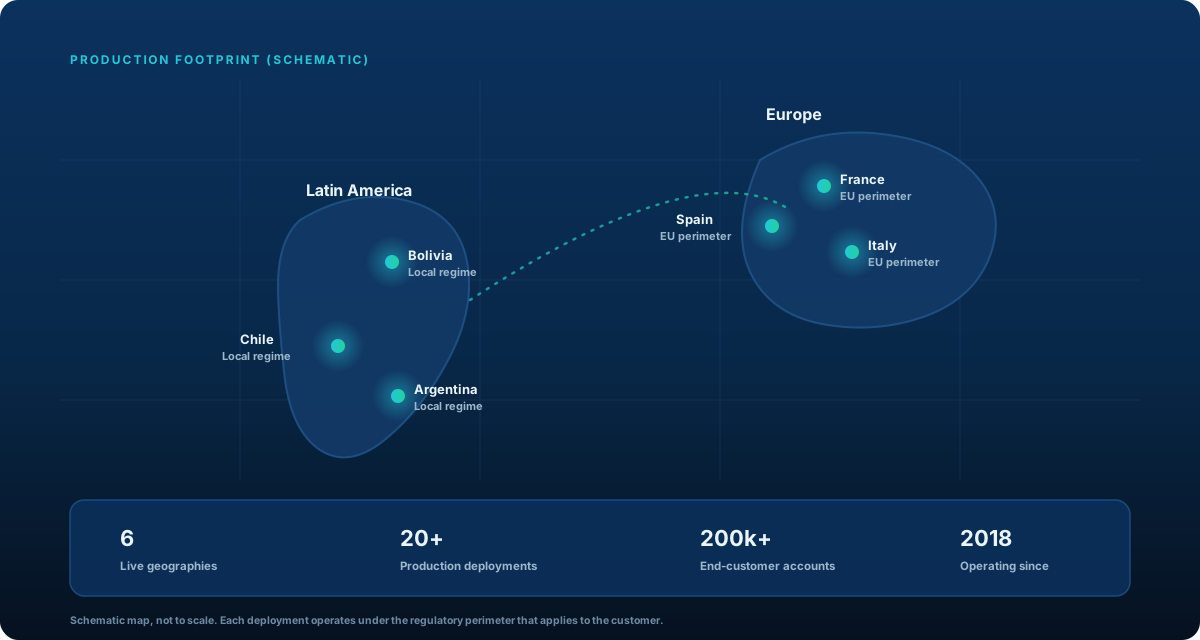
Italy
Regulated lending, guaranty-consortium digitalization, EU-perimeter banking journeys.
Spain
EU-perimeter banking and lending workloads under the same single-market deployment shape.
France
EU-perimeter banking and lending workloads, including embedded-finance journeys.
Argentina
Local banking and consumer-credit deployments under the country's regulatory regime.
Chile
Local banking and consumer-credit deployments under the country's regulatory regime.
Bolivia
Local banking and consumer-credit deployments under the country's regulatory regime.
Deployment timeline
From first production workloads to 200k+ accounts.
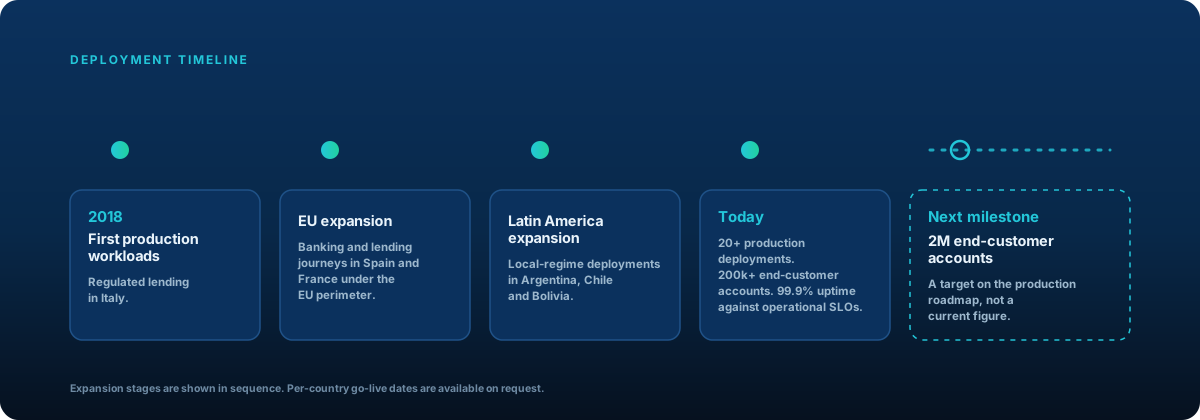
CoreFi has been operating production workloads since 2018: first regulated lending in Italy, then banking and lending journeys across the EU, then local-regime deployments in Latin America. The timeline below shows the sequence; per-country go-live dates are available on request.
Next milestone
From 200k to 2 million accounts.
The next operating milestone on CoreFi's production roadmap is 2 million end-customer accounts. To be explicit: that is a target, not a current figure, and it will move onto the proof bar only when production deployments put it there.
How the number grows
Three sources, all already in motion: existing customers growing their books on the platform, new customers going live on the 8–10 week first-journey path, and existing deployments extending into additional markets and products.
What it demands of the platform
The same architecture that runs 200k+ accounts today: cloud-native services, per-tenant isolation, and the governed AI workflow layer that lets operations scale without proportional headcount. The platform design is documented on /architecture.
How we will report it
The same way as today. The proof bar counts production accounts under the counting rules published above. As the figure moves, this page moves with it; we do not pre-announce the milestone as if it were already reached.
Anonymized case studies
Six production stories: segment, region, modules, timeline.
Client Outcomes now carries six anonymized stories: a digital lender at scale, a bank's AI onboarding, an EMI wallet program, a bank running CoreFi alongside legacy, a tokenized asset issuer and an embedded lending partner. The three tiles below link the stories with a published long-form article behind them.
Lender / Italy
Italian guaranty consortium digitalization.
An Italian guaranty consortium digitalizing origination, decisioning and servicing on CoreFi's integrated lending stack, without rebuilding the core. Anonymized story; per-story fields and outcome ranges in the article.
Read the anonymized story →Lender / EU
Direct digital lending on a Lending-as-a-Service stack.
A regulated financial institution running a direct-lending book on CoreFi's LaaS: origination, underwriting, servicing, payments and reporting, without diverting capital or headcount from its primary business.
Read the anonymized story →Fintech / EU
Consumer BNPL on a governed core.
A consumer-finance fintech tailoring Buy-Now-Pay-Later journeys on CoreFi's Customer Onboarding, Headless APIs and Core Banking Engine, with the same audit record as the rest of the platform.
Read the anonymized story →Partner ecosystem
Hundreds of integrations behind every CoreFi deployment.
Every production deployment of CoreFi rests on the same ecosystem layer: KYC and identity providers, payment rails, scoring engines, data vendors and regulatory-reporting connectors. Customers compose the providers their jurisdiction and use case demand; CoreFi keeps the audit record, the policy gates and the customer relationship in one place.
KYC & identity
Onboarding providers covering identity verification, document checks, AML screening and ongoing review, integrated through the same governed perimeter as the core.
Payments
Domestic and cross-border payment rails, card schemes and account-to-account providers, available on request and integrated via configured providers per jurisdiction.
Scoring & data
Credit-scoring engines, bureau data, open-banking data and alternative-data providers, wired into the lending workflows behind a single audit trail.
Specific providers per jurisdiction are available on request. We do not publish the full list to avoid implying integrations that are not active in a given deployment.
How customers put CoreFi into production
Five adoption paths. Same platform underneath.
Every production deployment on this page started on one of five implementation paths: Launch New, Modernize One Journey, Run Alongside Legacy, Migrate Progressively, or Operate as a Managed Platform. The platform is the same; what differs is what CoreFi replaces, what it sits next to, and how fast.
Where the baseline goes next
200k+ accounts is the starting point of the growth model.
The production figures on this page are the verified baseline of CoreFi's scaling model: from 200K end users toward 2 million through onboarding conversion, lending optimization, partner distribution and multi-country replication. The model is strategic, not a promised user count, and it runs on the same core and control plane documented here.
See what these deployments look like in detail.
Client Outcomes opens up the anonymized stories behind these production figures: segment, region, problem, modules used, outcome ranges, implementation timeline and the next phase, on the same axes for all six stories.